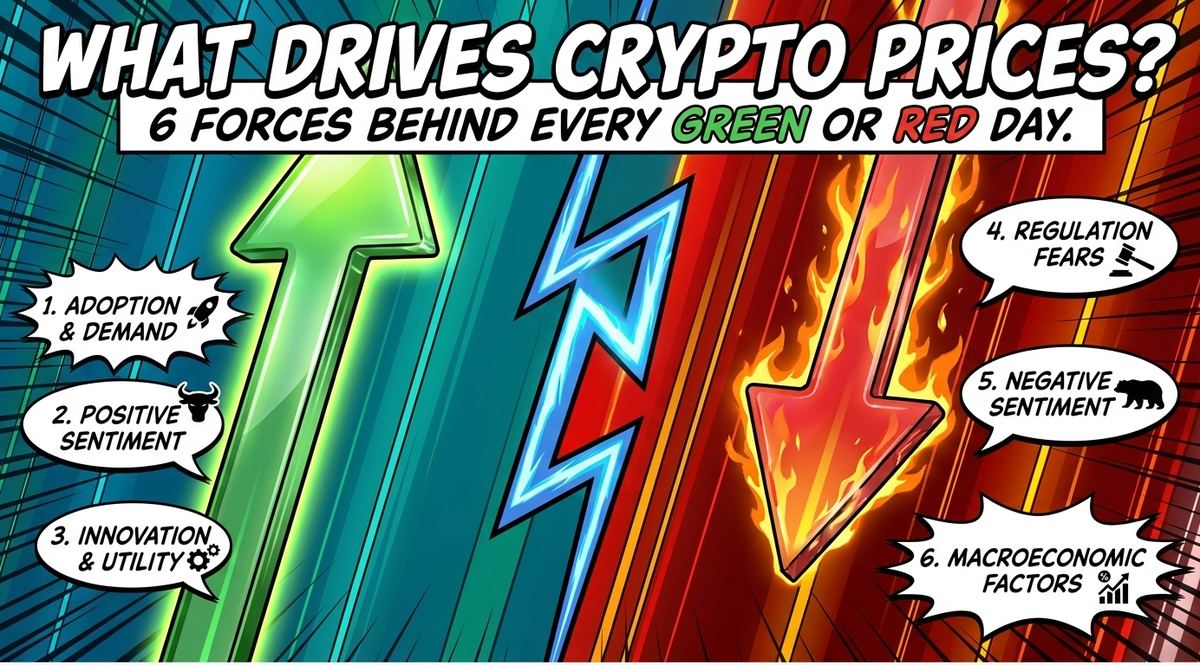
Crypto price moves can seem to come out of nowhere, but nearly every daily move traces back to some combination of a fairly small set of underlying forces.
1. Adoption and demand
Growing real-world usage of a network or asset — new applications, new users, new integrations — tends to support demand over time. This is a slower-moving force than most of the others on this list, but it's the foundation that longer-term price trends are typically built on.
2. Market sentiment
Collective mood — optimistic or pessimistic — can move prices independent of any specific new development, simply through the FOMO and FUD dynamics covered in our trading psychology piece. Sentiment can amplify moves that started for other reasons, or occasionally drive moves on its own.
3. Innovation and utility
Technical developments — network upgrades, new features, expanded use cases — can shift how a project is valued. This is closely related to adoption but distinct: innovation is about what becomes possible, while adoption is about how many people actually use it.
4. Regulatory developments
Government and regulatory actions, or even just anticipated actions, can move prices sharply, particularly for assets closely tied to specific institutional or geographic contexts — the kind of catalyst discussed in our XRP explainer.
5. Macroeconomic conditions
Broader financial conditions — interest rates, inflation data, general risk appetite across markets — increasingly correlate with crypto price movements, especially for large-cap assets that trade alongside traditional risk assets during major macro events.
6. Market mechanics
Liquidity, leverage, and order book depth — covered in our liquidations explainer — determine how much a given amount of buying or selling pressure actually moves the price, independent of the underlying reason behind that pressure.
Most real price moves reflect two or more of these forces overlapping at once, which is exactly why isolating a single clean "cause" for any given day's move is often harder than headlines make it sound.