What Whales Are and How Their Trades Ripple Through the Market
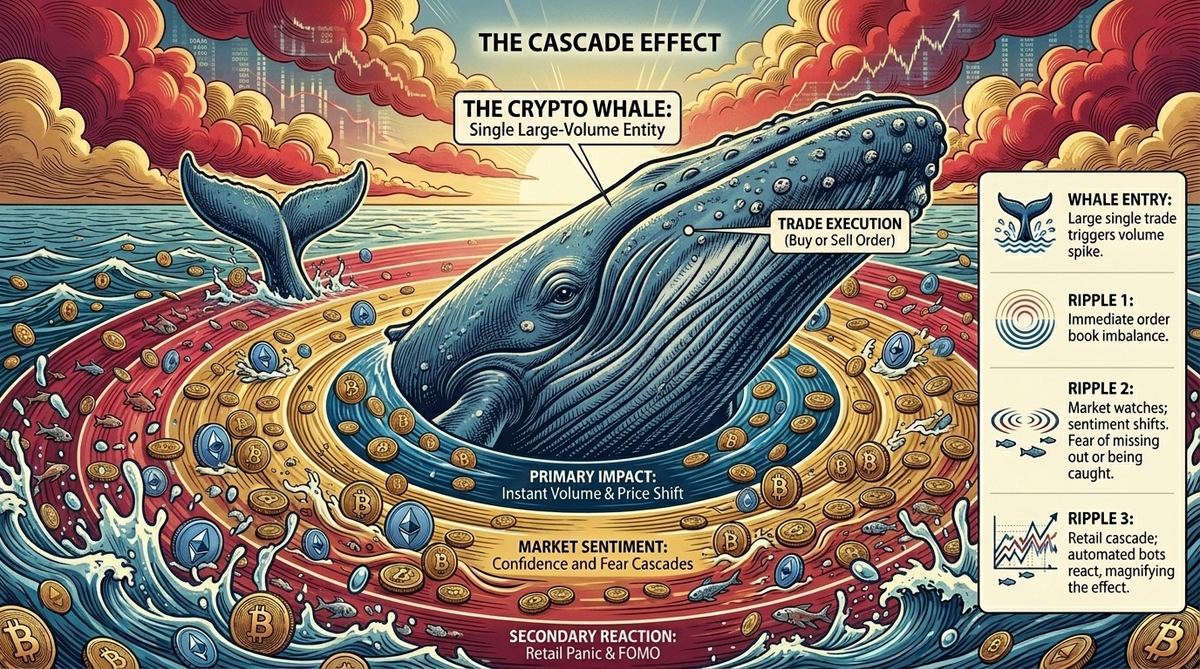
The term "whale" gets used constantly in crypto commentary, often without much explanation of why a single participant's trades matter enough to talk about individually.
What makes someone a whale
A whale is simply a holder or trader whose position is large enough that their individual buying or selling can noticeably move a market on its own — a threshold that depends heavily on the specific asset's typical trading volume and order book depth. The same dollar amount that would barely register for Bitcoin could move a smaller-cap coin substantially.
Why one trade can move a whole market
Markets with thinner order books, as covered in our volatility explainer, have less depth to absorb a large order without the price shifting significantly. A whale-sized trade in a lower-volume asset can produce a price move visible on the entire heatmap, while the same trade in Bitcoin might barely be noticeable.
The ripple effect beyond the initial trade
A large trade's impact often extends beyond its direct price effect. Other market participants who notice the move may react to it — some following the momentum, others growing cautious — which can extend the initial price impact well past what the original trade alone would explain. This secondary reaction is part of why whale activity is watched so closely: the first-order effect and the second-order market response often blend together in the data.
Reading unusual activity as a signal, not a certainty
An unusually large volume spike relative to a coin's typical activity — visible by comparing current volume to its market cap, the same ratio covered in our market cap vs. volume piece — can be a sign of whale activity, but it isn't a guaranteed signal of what happens next. It's most useful as a prompt to look closer at a coin's chart and recent history, not as a standalone conclusion.
← Back to Blog